

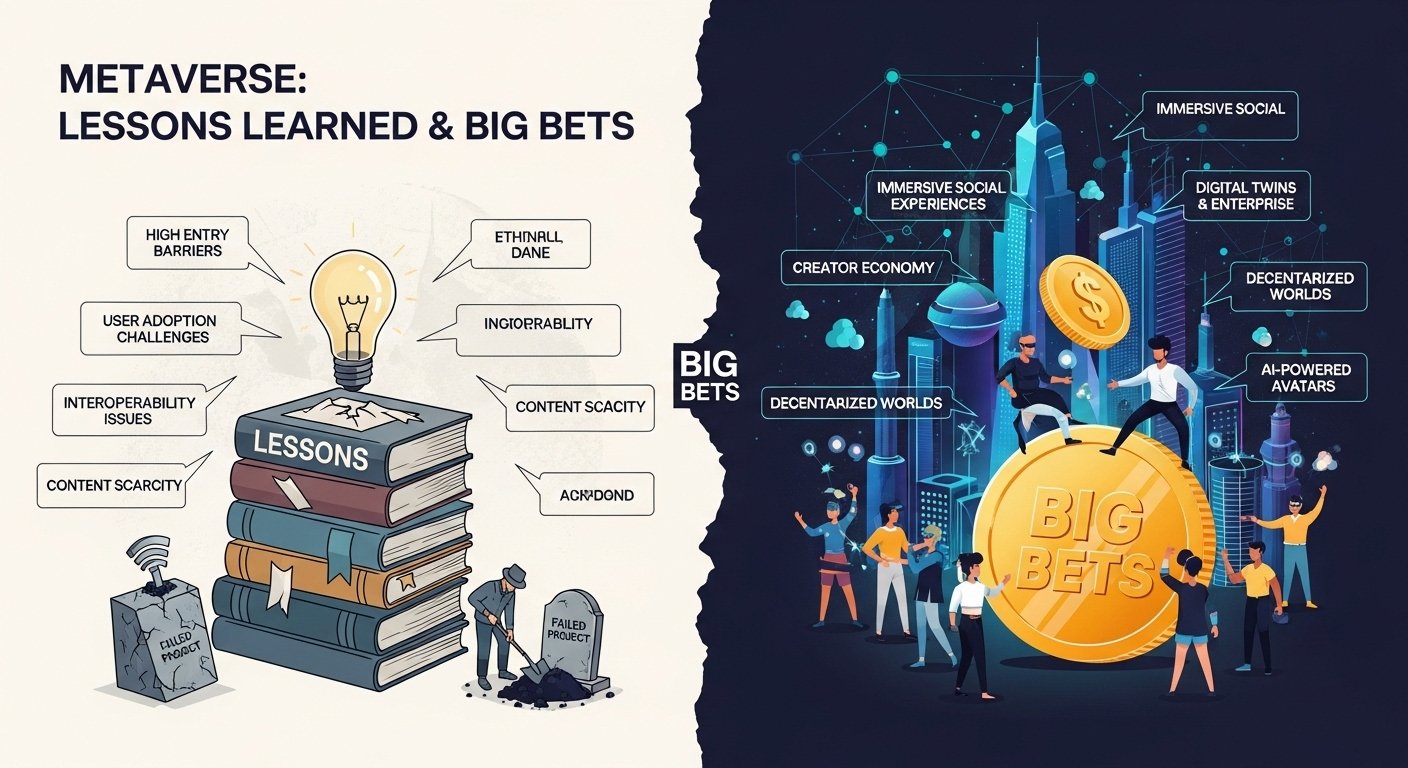
Metaverse Lessons Learned Big Bets Need Real Use Cases the metaverse once stood at the center of global technology conversations, attracting billions in investment, widespread media attention, and bold predictions about a new digital frontier. Tech giants, startups, gaming companies, and even fashion brands rushed to claim their share of this virtual universe. The promise was simple yet powerful: a persistent digital world where people could work, play, socialize, and transact seamlessly across virtual environments. It was presented as the next evolution of the internet.
However, as the initial hype faded, many of these ambitious projects encountered significant challenges. User adoption remained limited, platforms struggled to retain engagement, and some high-profile investments failed to deliver the expected returns. These outcomes did not signal the end of the metaverse concept, but they did reveal an important truth. Big bets in emerging technologies cannot succeed on vision alone. They require real, practical, and compelling use cases that deliver clear value to users.
The metaverse lessons learned from this period offer valuable insights not just for virtual worlds but for the entire technology industry. They show that innovation must be grounded in real needs, user behavior, and sustainable business models. The story of the metaverse is not one of failure, but of recalibration. It is a reminder that even the most transformative ideas must prove their usefulness before they can reshape society.
Metaverse Lessons Learned Big Bets
The metaverse concept gained global attention when major technology companies began positioning it as the next stage of digital interaction. Corporations invested billions into virtual worlds, immersive technology, and digital economies , expecting rapid adoption similar to the rise of smartphones or social media.
Venture capital flowed into startups promising blockchain metaverse platforms, virtual land ownership, and NFT-based economies. Companies envisioned entire cities, workplaces, and entertainment hubs inside digital spaces. The narrative was that the metaverse would become a parallel internet where people would spend significant portions of their daily lives.
Media Buzz and Unrealistic Expectations
Media coverage amplified the excitement, often portraying the metaverse as an inevitable future rather than a developing technology. Headlines promised revolutionary digital experiences, virtual reality social spaces, and a new era of online identity and ownership.
However, this hype cycle created expectations that were difficult to meet. Many platforms launched without clear value propositions, assuming users would naturally migrate into virtual worlds simply because they existed. The lack of practical applications soon became apparent.
The Reality Check: Adoption Challenges
Low User Engagement in Early Platforms
Despite massive investments, many metaverse platforms struggled to attract and retain users. Some virtual worlds reported surprisingly low daily activity compared to traditional social media or gaming platforms.
The core issue was not technology alone but the absence of compelling reasons for users to participate. Without meaningful activities, people had little motivation to spend time in 3D virtual environments.
High Barriers to Entry
Another major challenge was accessibility. Many metaverse experiences required expensive hardware, high-performance computers, or specialized headsets. This created friction for mainstream users who were accustomed to simple, mobile-friendly applications.
Additionally, the user experience in many platforms felt unfinished. Awkward interfaces, limited interactions, and technical glitches made it difficult for new users to see the value of these immersive digital ecosystems.
Why Real Use Cases Matter
Technology Without Purpose Fails to Scale
One of the most important metaverse lessons learned is that technology alone does not drive adoption. People do not embrace platforms because they are futuristic; they adopt them because they solve real problems or provide meaningful benefits.
Successful digital platforms historically followed this pattern. Social media succeeded because it connected people easily. Streaming services grew because they offered convenient entertainment. Smartphones became essential because they combined multiple daily functions into a single device.
In contrast, many metaverse projects launched without a clear answer to a simple question: what problem does this solve for the average user?
The Difference Between Vision and Utility
Vision is essential for innovation, but utility determines survival. A virtual world with no compelling activities becomes an empty environment, no matter how advanced the technology behind it.
Real use cases provide reasons for users to return. These might include virtual collaboration tools, digital marketplaces, interactive training environments, or immersive entertainment experiences. When users see tangible value, engagement grows naturally.
Successful Use Cases Emerging in the Metaverse
Gaming as the Primary Driver
Gaming remains the strongest and most successful metaverse use case. Players are already comfortable with virtual environments, digital assets, and online communities. Games provide clear goals, rewards, and social interaction, making them natural metaverse experiences.
The success of multiplayer games demonstrates that users will spend significant time in virtual worlds when the experience is engaging and rewarding.
Enterprise and Remote Collaboration
Another promising area is business collaboration. Virtual meeting spaces and immersive work environments allow teams to interact in ways that traditional video calls cannot replicate. These tools are especially useful for design, engineering, and training scenarios.
Companies are exploring virtual offices where employees can collaborate in real time, review 3D models, and simulate real-world processes.
Education and Training
The metaverse also offers strong potential in education and professional training. Virtual reality training simulations can replicate complex or dangerous scenarios in a safe environment.
Medical students, pilots, engineers, and emergency responders can practice skills in realistic virtual settings, improving learning outcomes while reducing costs and risks.
Virtual Commerce and Digital Goods
Digital commerce is another area showing promise. Users are willing to purchase virtual assets, digital fashion, and in-game items when they hold social or functional value.
Brands are experimenting with virtual storefronts, product launches, and immersive shopping experiences. These efforts show that the metaverse can support real economic activity when tied to user interests.
Lessons for Tech Companies and Investors
Avoid Chasing Buzzwords
One of the clearest metaverse lessons learned is the danger of investing in trends without understanding the underlying demand. Buzzwords can attract attention, but they cannot sustain long-term growth. Companies that focused on hype rather than user value often struggled to retain audiences.
Build Around User Behavior
Successful platforms are built around how people actually behave, not how companies imagine they might behave in the future. Understanding user habits, preferences, and daily routines is essential.
Metaverse projects that align with existing behaviors, such as gaming, social interaction, or remote work, have a better chance of success.
Focus on Interoperability and Accessibility
Another important lesson is the need for accessible and interconnected experiences. Users are unlikely to adopt platforms that require expensive hardware or lock them into isolated ecosystems.
Future metaverse development will likely focus on cross-platform compatibility, mobile access, and seamless user experiences.
The Role of Blockchain and Digital Ownership
Promise and Limitations
Blockchain technology was often presented as the backbone of the metaverse, enabling digital ownership, NFT economies, and decentralized platforms. While these concepts introduced new possibilities, they also faced challenges. Many early blockchain-based metaverse projects prioritized speculation over utility. Virtual land sales and token economies attracted investors, but they did not always create engaging experiences for users.
The Shift Toward Utility-Driven Models
The industry is gradually shifting toward practical applications of blockchain within the metaverse. Instead of focusing solely on asset speculation, developers are exploring ways to use blockchain for identity management, secure transactions, and cross-platform ownership. This shift reflects a broader understanding that real-world utility must come before financial speculation.
The Importance of Hardware and User Experience
Current Limitations of VR and AR Devices
Hardware remains one of the biggest barriers to mass metaverse adoption. Many virtual reality headsets are still expensive, bulky, or uncomfortable for long-term use.
Until VR headsets and augmented reality devices become more affordable, lightweight, and user-friendly, mainstream adoption will remain limited.
The Path Toward Seamless Integration
Future progress will depend on making immersive technology feel natural and intuitive. Just as smartphones became indispensable once they combined multiple functions into one device, metaverse hardware must offer clear advantages over existing tools. Improved displays, better battery life, and comfortable designs will play a crucial role in this transition.
Cultural and Social Factors
The Human Element of Virtual Worlds
Technology alone cannot build a thriving metaverse. Culture, community, and social interaction are equally important. Virtual spaces must feel meaningful, inclusive, and engaging.
Communities that form around shared interests, creativity, or collaboration are more likely to thrive than empty digital environments built purely for speculation.
Trust and Safety in Virtual Environments
As virtual worlds grow, issues such as privacy, harassment, and digital identity become more significant. Building safe and trustworthy environments is essential for long-term adoption.
Platforms must invest in moderation tools, user protections, and transparent governance systems to create sustainable digital societies.
The Road Ahead for the Metaverse
From Hype to Practical Innovation
The metaverse is moving from a hype-driven phase to a more practical stage of development. Companies are focusing on specific use cases rather than grand, all-encompassing visions. This shift is healthy for the industry. It encourages sustainable growth, realistic expectations, and products that solve real problems.
Long-Term Potential Remains Strong
Despite early setbacks, the long-term potential of the metaverse remains significant. As technology improves and use cases mature, virtual worlds could become important parts of work, education, entertainment, and commerce. The key difference is that future growth will likely be gradual and use-case driven rather than fueled by speculative hype.
Conclusion
The metaverse journey has provided valuable lessons for the technology industry. It demonstrated that bold visions alone are not enough to guarantee success. Even the most ambitious innovations must deliver clear, practical value to users.
The biggest metaverse lessons learned revolve around the importance of real use cases, user-centric design, accessible technology, and sustainable business models. Platforms that focus on meaningful experiences rather than speculative hype are more likely to succeed.
As the industry evolves, the metaverse will likely become less of a single, unified concept and more of a collection of specialized virtual experiences. Gaming, enterprise collaboration, education, and digital commerce are already showing signs of long-term viability. The future of the metaverse will not be defined by headlines or billion-dollar investments. It will be shaped by the platforms that solve real problems, enhance daily life, and provide genuine value to users.
FAQs
Q: Why did many early metaverse projects struggle to gain users?
Many early metaverse platforms focused heavily on vision and technological novelty without offering clear, practical benefits for everyday users. People tend to adopt new technologies when they solve real problems or provide strong entertainment value. Without compelling activities, intuitive interfaces, or affordable hardware, many users saw little reason to spend time in virtual worlds. This led to low engagement levels despite large investments and high expectations.
Q: What are the most successful use cases in the metaverse today?
Gaming remains the strongest and most proven metaverse use case because it naturally combines virtual environments, social interaction, and digital economies. Enterprise collaboration tools, virtual training simulations, and immersive education platforms are also showing strong potential. These areas provide clear value, making them more likely to drive sustained adoption.
Q: How important is hardware to the future of the metaverse?
Hardware plays a critical role in metaverse adoption. Current virtual reality and augmented reality devices can be expensive, uncomfortable, or limited in functionality. For the metaverse to reach mainstream audiences, hardware must become more affordable, lightweight, and easy to use. Advances in display technology, battery life, and design will significantly influence the pace of adoption.
Q: What role does blockchain play in the metaverse?
Blockchain technology can enable digital ownership, secure transactions, and decentralized identity systems within virtual environments. However, many early projects focused more on speculation than practical use. The industry is now shifting toward utility-driven applications of blockchain, where it supports real user experiences instead of serving as the main attraction.
Q: Is the metaverse still relevant after the hype cycle?
Yes, the metaverse remains relevant, but the focus has shifted from hype to practical innovation. Instead of trying to build massive virtual worlds all at once, companies are now concentrating on specific use cases that deliver real value. This more realistic approach is likely to produce sustainable growth and meaningful technological progress over time.
