

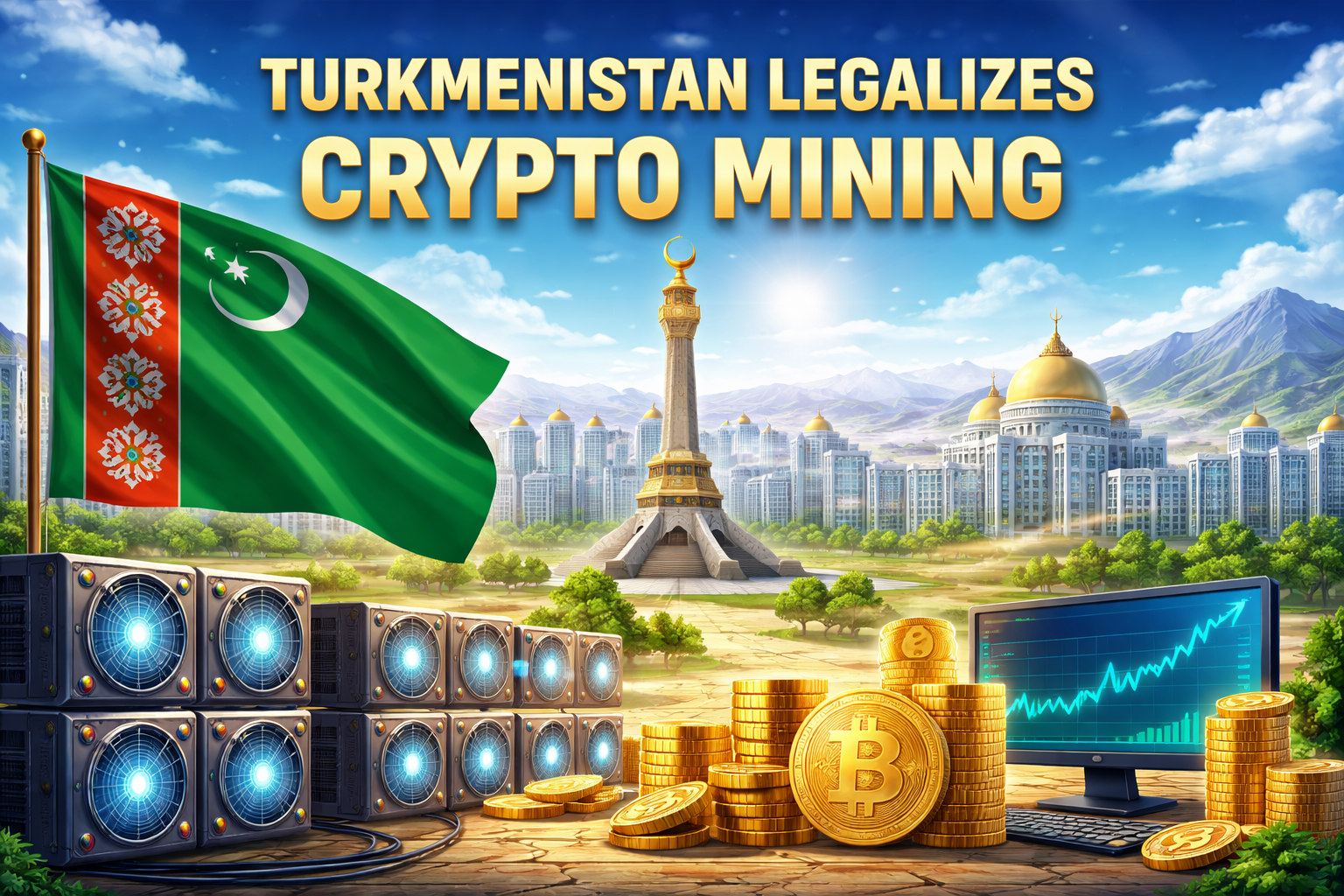
Turkmenistan Legalizes Crypto Mining and Exchanges to Boost Economy, marking a significant policy shift for one of the world’s most controlled and energy-dependent nations. Effective January 1, 2026, the new virtual assets law signed by President Serdar Berdimuhamedov establishes a legal framework designed to bring digital asset activities into the formal economy while stimulating economic diversification and attracting foreign investment.
Historically reliant on natural gas exports and characterized by strict state controls, Turkmenistan’s strategic embrace of blockchain technology, digital currency regulation, and crypto infrastructure development represents a major leap toward integration with global financial trends. Unlike previous periods when cryptocurrencies operated in a legal gray zone, the new legislation clearly defines the rights and responsibilities of miners, exchanges, and other participants in the digital asset ecosystem. This article explores the multifaceted implications of this landmark decision, from economic prospects and regulatory structure to potential challenges and broader regional context.
The Economic Imperative: Diversifying a Gas-Dependent Economy
Turkmenistan’s economy has long been anchored in its rich natural gas reserves, making it one of the largest exporters to markets like China. However, dependence on a single export commodity leaves the nation vulnerable to global price shocks and demand fluctuations. Recognizing this exposure, policymakers have increasingly sought avenues for economic diversification, with digital assets emerging as a promising frontier.
The new law on virtual assets serves as more than just a regulatory milestone; it represents a broader economic strategy. By offering legal clarity for crypto mining operations and the establishment of licensed exchanges, the government aims to attract foreign capital, stimulate technological innovation, and create high-value economic sectors outside the traditional energy framework. This shift aligns with global trends where countries leverage digital finance to foster new industries and increase competitiveness in the digital age.
The decision to treat cryptocurrencies as objects of civil law—as opposed to legal tender—strikes a balance between embracing innovation and maintaining monetary sovereignty. Although digital currencies are not recognized as official payment methods, their regulated use in mining and trading opens the door to investment, entrepreneurship, and new forms of revenue generation within the Turkmen economy.
A Clear Regulatory Structure for Miners
Under the newly enacted legislation, cryptocurrency mining has transitioned from an unregulated activity to a legally recognized economic sector in Turkmenistan. The law ensures that individuals and businesses seeking to mine digital currencies such as Bitcoin or Ethereum can do so under clearly defined conditions, which include registration, compliance with technical and safety standards, and oversight by the Central Bank of Turkmenistan.
This formalization is crucial for both domestic and international investors. Previously, the absence of legal status for mining deterred investment and left significant uncertainty around how activities might be treated under criminal or civil law. With the new framework, potential miners know exactly what is expected of them, including registration procedures and operational limits. The requirement to register mining equipment and maintain valid wallets further enhances transparency and helps authorities monitor energy consumption and environmental impact.
Turkmenistan’s abundant and inexpensive energy resources give it a unique advantage in the global crypto mining landscape. Mining cryptocurrencies is energy-intensive, and nations with lower electricity costs often become hubs for large-scale operations. By providing a legal setting for mining, Turkmenistan can harness its energy wealth in new ways—permitting technology enterprises to flourish on a foundation of local resources while generating economic value extracted from global markets.
Structured Oversight for Trading Platforms
The legalization of cryptocurrency exchanges under the new law represents another cornerstone in Turkmenistan’s digital asset strategy. Exchange platforms will operate under a licensing regime administered by the Central Bank, with strict compliance requirements, including know-your-customer (KYC) and anti-money-laundering (AML) standards. 
This framework seeks to balance innovation with financial stability. By requiring exchanges to meet regulatory standards before granting licenses, Turkmenistan aims to protect investors, reduce fraud, and integrate digital asset trading into a legitimate financial ecosystem. While cryptocurrencies will remain outside the formal monetary system—as they are not recognized as legal tender or securities—their regulated trading provides an avenue for investment and economic participation.
The licensing approach also signals openness to international participation, although the law enforces limitations on the use of state symbols and names by crypto enterprises to prevent any misinterpretation of official state backing. Advertising and promotional materials are also subject to strict rules that warn of investment risks and prohibit misleading claims—a move intended to safeguard consumers.
Financial Inclusion and Market Potential
Establishing licensed exchanges has implications beyond regulation—it facilitates broader financial inclusion. In countries with limited access to traditional banking services, digital asset platforms provide alternative financial instruments that can foster savings, cross-border transactions, and access to global financial markets. Although Turkmenistan’s internet infrastructure remains tightly regulated, the creation of legal channels for crypto trading can stimulate local demand for digital finance solutions and spur growth in related sectors, such as fintech development and digital security services.
By positioning itself within the global network of digital finance, Turkmenistan can attract both retail and institutional interest, potentially leveraging its status as a newly regulated market to draw investment and expertise. This development could open doors for local entrepreneurs and international partnerships, fostering a digital ecosystem that grows alongside the broader economy.
Attracting Foreign Investment
One of the clearest economic benefits of legalizing crypto mining and exchanges is the potential to attract foreign direct investment (FDI). Global cryptocurrency enterprises and mining firms often seek jurisdictions with clear legal frameworks, stable governance, and economic incentives. Turkmenistan’s law aims to meet these criteria by creating predictable rules for participation and oversight.
The presence of guided regulatory structures can give confidence to investors who may otherwise be hesitant to enter emerging markets. Clear licensing requirements and a commitment to compliance signal that Turkmenistan is ready to engage with the global financial community. As capital flows in, this investment could support infrastructure development, technological upgrades, and job creation—bringing long-term benefits that extend beyond the crypto industry.
Encouraging foreign investment also complements the government’s broader strategy to reduce reliance on gas exports, which have historically dominated the national economy. By fostering a climate where digital innovation is legally recognized and economically incentivized, Turkmenistan may create ripple effects across multiple sectors.
Revenue Generation and Tax Framework
Although details on taxation were not immediately specified in the initial rollout of the law, the legalization of crypto activities implies potential revenue streams for the state in the form of licensing fees, corporate taxes, and compliance fines. These inflows can be reinvested into public infrastructure, education, and technology initiatives. As mining operations expand and exchanges begin to operate at scale, their contributions to public finance could become significant.
Additionally, the move toward economic digitization aligns with global trends toward fintech adoption, which can further diversify revenue sources and broaden the economic base. For a country seeking to modernize, integrating digital finance with existing economic structures can unlock new opportunities for growth, collaboration, and innovation.
Central Asia’s Emerging Digital Asset Hub
Turkmenistan’s legalization of crypto mining and exchanges positions it within a rapidly evolving regional ecosystem in Central Asia. Neighboring countries such as Kazakhstan, Uzbekistan, and Kyrgyzstan have also pursued cryptocurrency regulation and blockchain initiatives, each forging pathways toward structured digital economies.
Turkmenistan’s structured approach—characterized by licensing, regulatory compliance, and a cautious stance on monetary recognition—mirrors broader trends across the region. While the country remains cautious about the use of digital currencies as everyday money, its embrace of regulated mining and trading demonstrates a willingness to participate in the global blockchain revolution. This alignment enhances the region’s attractiveness to international crypto enterprises seeking emerging markets with clear regulatory landscapes.
In this context, Turkmenistan may benefit from cross-border collaboration, knowledge sharing, and increased visibility within international crypto networks. By fostering an environment of legal clarity and economic openness, the country contributes to the broader Central Asian narrative of digital asset adoption and technological modernization.
Regulatory and Compliance Complexities
While the legalization of crypto mining and exchanges opens doors, it also introduces regulatory challenges. Implementing effective oversight requires expertise, institutional capacity, and continual adaptation to the fast-changing world of digital finance. Ensuring compliance with AML and KYC standards is critical, but it also demands robust infrastructure and knowledgeable enforcement personnel.
There is also the risk of market volatility affecting investor confidence. Cryptocurrencies are known for rapid price fluctuations, which can amplify both gains and losses for participants. Without proper education and protective measures, retail investors may face significant financial risks.
Environmental and Infrastructure Considerations
Crypto mining, by nature, consumes large amounts of energy. Although Turkmenistan enjoys relatively low electricity costs due to its natural gas reserves, scaling mining operations could place stress on local infrastructure. Managing energy distribution, ensuring grid stability, and balancing mining demands with other national needs will require prudent planning and investment.
Moreover, internet accessibility and digital literacy remain important factors. For the average Turkmen citizen to benefit from this new economic sector, improvements in connectivity, online security, and technological education will be necessary.
Conclusion
Turkmenistan’s decision to legalize crypto mining and cryptocurrency exchanges under a comprehensive regulatory framework represents a bold and strategic pivot toward economic diversification and technological modernization. As of January 1, 2026, the new law brings clarity to digital asset activities, invites investment, and aligns the country with a global movement toward regulated blockchain adoption.
By formalizing mining operations and licensing exchanges, Turkmenistan is building a foundation for growth beyond energy exports. While challenges remain—including regulatory enforcement, market volatility, and infrastructure demands—the potential for economic transformation is clear. As part of a broader Central Asian crypto landscape, Turkmenistan now stands poised to participate more fully in global digital finance, drawing attention from investors, innovators, and policymakers alike.
FAQs
Q. When did Turkmenistan legalize crypto mining and exchanges?
Turkmenistan’s law legalizing cryptocurrency mining and exchanges officially took effect on January 1, 2026, after being signed by President Serdar Berdimuhamedov.
Q. Can cryptocurrencies be used as legal tender in Turkmenistan?
No. While crypto mining and trading are legal under the new law, cryptocurrencies are not recognized as legal tender, currency, or securities in the country.
Q. Who regulates crypto exchanges in Turkmenistan?
Licensed crypto exchanges and virtual asset service providers are regulated by the Central Bank of Turkmenistan, which administers licensing, compliance, and oversight.
Q. Is individual crypto mining allowed?
Yes, both individual entrepreneurs and corporate entities are permitted to engage in cryptocurrency mining, provided they register and comply with regulatory standards.
Q. What are some compliance requirements for crypto activities?
Crypto participants must adhere to strict KYC and AML protocols, register their operations, and ensure transparent practices, including limiting anonymous wallets and marketing with risk disclosures.
