

The NFT market has always been synonymous with volatility, but November 2025 presented one of its most challenging chapters. With monthly sales volumes plummeting to $320 million, a staggering 50% decrease from October’s $629 million, the digital collectibles space is facing its most significant downturn of the year. Major NFT collections saw double-digit declines. NFT Market: market capitalization dropped by 66% from January’s peak of $9.2 billion to just $3.1 billion, and early December data painted an even bleaker picture with only $62 million in weekly sales, marking the weakest start to a month in 2025.
This downturn has sparked a familiar debate within the cryptocurrency and digital asset communities. Is this the death knell for non-fungible tokens, or are we simply witnessing another cyclical correction in an industry known for its boom-and-bust patterns? The answer, as with most complex market phenomena, lies somewhere in between these extremes. Understanding the forces behind November’s dramatic slump requires examining structural shifts, macroeconomic pressures, evolving use cases, and historical patterns that have defined the NFT ecosystem since its mainstream emergence.
The stakes are particularly high because this isn’t just about speculative digital art anymore. The blockchain technology underpinning NFTs has expanded into gaming, real estate tokenization, digital identity verification, and enterprise applications. Whether this November slump represents a temporary setback or a fundamental reckoning will shape not just the future of digital collectibles but the broader trajectory of Web3 innovation and decentralized ownership models.
The November 2025 NFT Market Decline
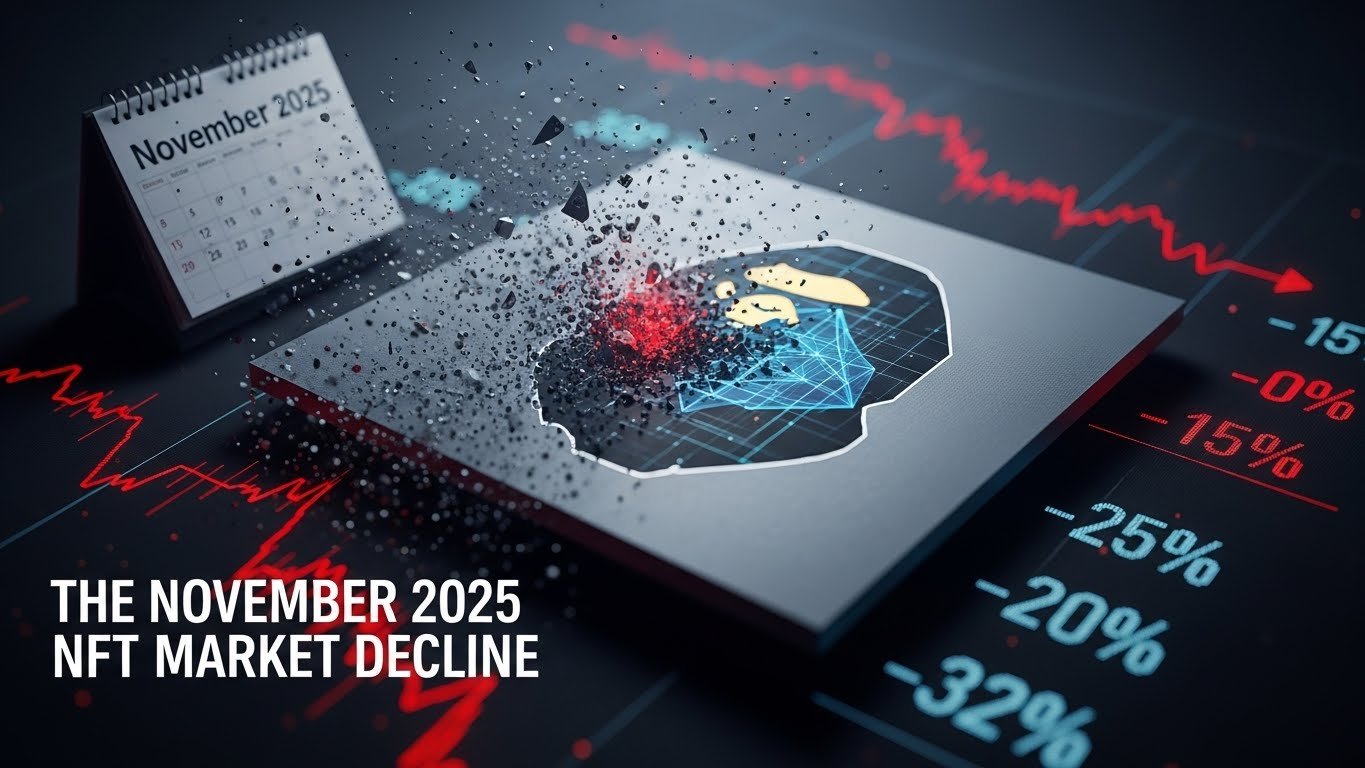
The numbers from November 2025 tell a sobering story for anyone invested in the NFT space. According to multiple industry trackers, the month delivered one of the weakest performances since the sector’s early days, with aggregate monthly sales volumes returning to levels last seen in September 2024. The decline wasn’t isolated to overall market metrics; it permeated virtually every major collection and marketplace, creating a widespread sense of uncertainty about the sector’s immediate future.
CryptoPunks, long considered the blue-chip standard of the NFT world and the largest collection by market capitalization, fell 12% during the 30 days ending in November. Bored Ape Yacht Club, another cornerstone collection that symbolized the NFT boom of 2021-2022, declined 8.5%. Even newer collections that had shown promise earlier in the year couldn’t escape the downturn. Pudgy Penguins dropped 10.6%, while art-focused collections faced even steeper losses. Chromie Squiggle slipped 5.6%, Fidenza fell 14.6%, and Moonbirds experienced a 17.9% decline.
The most dramatic casualty was Hypurr, which shed an alarming 48% of its value, representing the biggest decline among the top ten NFT collections. This widespread erosion of value affected not just speculative projects but also established collections with years of community building and cultural significance behind them. However, the picture wasn’t entirely bleak. Two collections bucked the downward trend: Infinex Patrons posted gains of 14.9%, while Autoglyphs surged 20.9%, demonstrating that selective opportunities still exist for projects with strong fundamentals and clear utility propositions.
The early December data extended the concerning trend, with the first week producing only $62 million in sales. This marked the weakest weekly performance of 2025 and suggested that the downturn wasn’t simply a November anomaly but potentially the beginning of a more sustained correction. The question on everyone’s mind became whether this represented a temporary liquidity crunch or the start of a longer NFT winter that could extend well into 2026.
Root Causes Behind the Market Contraction
Multiple interrelated factors contributed to November’s sharp market contraction, creating a perfect storm that exposed underlying weaknesses in the NFT ecosystem. Understanding these causes is essential for determining whether the current slump represents a fatal flaw or a necessary correction that could ultimately strengthen the market’s foundations.
First and foremost, macroeconomic conditions played a significant role in dampening investor enthusiasm. Throughout 2025, global financial markets grappled with persistent interest rate uncertainty, geopolitical tensions, and concerns about recession risks in major economies. These broader economic headwinds reduced disposable capital available for speculative investments like NFTs. When investors face uncertainty, they typically retreat from higher-risk assets, and NFTs, despite their maturation over recent years, still occupy a relatively speculative position in most portfolios.
The correlation between cryptocurrency market performance and NFT valuations became particularly evident during this period. As the broader crypto market experienced corrections in late 2025, the NFT sector felt the ripple effects acutely. Since most NFT transactions occur using cryptocurrencies like Ethereum, declining crypto prices create a double impact: reduced purchasing power for potential buyers and psychological discouragement from market participants who see their overall digital asset portfolios declining.
Another critical factor was market oversaturation. Years of low-barrier minting and increasingly accessible creation tools produced an overwhelming number of new collections and one-off drops. This proliferation created intense competition for collector attention and capital without necessarily improving the overall quality or utility of offerings. The market became flooded with derivative projects, cash-grab collections, and poorly conceived experiments that diluted the value proposition of legitimate projects. As collectors became more discerning, they pulled back from speculative purchases, waiting for clearer signals of long-term value.
Trust issues also continued to plague the sector. Despite improvements in marketplace security and verification processes, the NFT space still experiences regular incidents of fraud, stolen artwork, pump-and-dump schemes, and rug pulls. These recurring problems eroded confidence among both new entrants and seasoned collectors. When trust declines, liquidity dries up, creating a self-reinforcing downward spiral where falling prices discourage participation, which further reduces prices.
Perhaps most significantly, the market is undergoing a fundamental shift in how value is assessed. The speculative frenzy of 2021-2022, where projects could achieve stratospheric valuations based primarily on hype and community enthusiasm, has given way to more rational evaluation criteria. Collectors and investors increasingly demand tangible utility, genuine artistic merit, technical innovation, or real-world applications. Projects that cannot articulate clear value propositions beyond “number go up” are being ruthlessly filtered out of the market, contributing to the overall decline in sales volumes and valuations.
Historical Patterns and Market Cycles
To properly contextualize November 2025’s downturn, it’s essential to examine the NFT market’s historical patterns and cyclical behavior. The sector has demonstrated remarkable resilience through previous corrections, suggesting that cyclical downturns might be an inherent feature rather than a fatal flaw of this emerging asset class.
The NFT market’s journey to mainstream awareness began with modest trading volumes and niche communities of digital artists and crypto enthusiasts in 2017-2019. The first significant boom occurred in 2020-2021, driven by several converging factors: increased institutional interest in cryptocurrency, pandemic-related shifts toward digital experiences, celebrity endorsements, and breakthrough sales like Beeple’s “Everydays: The First 5000 Days” fetching $69.3 million at Christie’s auction house.
This period saw market valuations soar to unprecedented levels, with the global NFT market reaching approximately $342.94 billion in 2022. Monthly trading volumes routinely exceeded $2 billion, and new collections sold out within minutes. However, this explosive growth proved unsustainable. The subsequent correction in 2022-2023 was severe, with trading volumes plummeting by over 60% from peak levels. Many observers declared the NFT experiment over, predicting that the technology would fade into obscurity alongside other hyped digital trends.
Yet the market didn’t disappear. Instead, it underwent a painful but necessary consolidation. The crypto winter of 2022-2023 forced projects to focus on genuine utility, community building, and sustainable business models rather than relying solely on speculative momentum. When the market showed signs of recovery in late 2024, it looked fundamentally different from its earlier iteration. Web3 gaming emerged as a significant driver, with games offering players practical ways to use NFTs beyond speculation. Real-world asset tokenization gained traction, and major brands began incorporating NFTs into loyalty programs and digital collectibles strategies.
The November 2025 slump must be viewed within this broader context of cyclical behavior. Previous downturns in the NFT space typically lasted 6-18 months before recovery began, driven by technological improvements, new use cases, or favorable macroeconomic conditions. The current correction shares characteristics with past cycles: oversupply following rapid expansion, reduced liquidity during broader market uncertainty, and market segmentation between utility-focused projects and purely speculative offerings.
Importantly, user engagement metrics tell a more nuanced story than sales volumes alone. Despite November’s poor performance, active wallet numbers remain substantial, with approximately 410,000 daily active NFT wallets recorded in 2025, representing a 9% year-over-year increase. The global user base sits at 11.58 million and is projected to reach 11.64 million by year’s end. These figures suggest that while trading enthusiasm has waned, fundamental engagement with blockchain-based ownership continues to grow steadily.
Emerging Use Cases and Market Evolution
Despite the challenging market conditions, the NFT sector is quietly evolving beyond its origins as a speculative digital collectibles market. These emerging applications could provide the foundation for sustainable growth that transcends cyclical boom-and-bust patterns, offering hope that November’s slump represents a transition rather than a terminal decline.
Gaming NFTs have emerged as the leading category in 2025, accounting for 38% of global NFT transactions. Unlike profile picture projects that derive value primarily from social signaling and community membership, gaming NFTs offer concrete utility: ownership of in-game items, characters, land, or assets that can be used, traded, or rented within virtual economies. Games like “Metal Valley” exemplify this trend by giving players the choice between conventional gameplay and blockchain-enabled ownership, appealing to both traditional gamers and crypto-native users. This approach addresses one of the major criticisms of earlier NFT gaming attempts: forcing blockchain mechanics on audiences that didn’t necessarily want them.
The real-world asset tokenization trend continues expanding rapidly, with NFTs representing fractional ownership of physical art, real estate, luxury goods, and collectibles. This segment grew 32% year-over-year and surpassed $1.4 billion in market size, demonstrating strong demand for bridging physical and digital ownership. Tokenizing real-world assets solves practical problems around provenance, fractional ownership, and transfer efficiency that exist in traditional markets, providing genuine value beyond speculation.
Fashion NFTs and digital wearables have reached a valuation of $890 million in 2025, driven by major luxury brands creating digital fashion lines for metaverse platforms and augmented reality applications. Companies like Gucci, Nike, and Louis Vuitton view NFTs not as speculative investments but as strategic extensions of their brand presence into digital spaces where younger consumers increasingly spend time. This enterprise adoption lends credibility and sustainability to the sector that pure speculation could never provide.
Identity NFTs used for decentralized identification, membership verification, and access control have gained significant adoption, with over 12 million issued in 2025. These applications address real problems around digital identity portability and self-sovereign data ownership, positioning NFTs as infrastructure rather than collectibles. Event ticketing NFTs now comprise 5.3% of ticket sales across major U.S. venues, offering benefits like verified authenticity, reduced fraud, and programmable secondary market controls that benefit both artists and fans.
AI-generated NFTs represent another frontier, though one fraught with questions about copyright, originality, and value. As artificial intelligence tools become more sophisticated, the intersection of AI and NFT technology creates opportunities for dynamic, evolving digital assets that blur traditional boundaries between creator and creation. Music NFTs have grown substantially, with streaming-linked tokens generating over $520 million in revenue, allowing artists to maintain direct relationships with fans and capture more value from their work.
These diverse applications suggest the NFT market is maturing from a monolithic speculative phenomenon into a differentiated ecosystem with multiple value propositions. Projects that survive the current downturn will likely be those that can articulate clear utility, solve real problems, or provide genuine artistic or cultural value rather than relying solely on speculative momentum.
Regional Variations and Global Market Dynamics
The November 2025 NFT slump didn’t affect all regions equally, revealing interesting patterns about global adoption, regulatory environments, and cultural attitudes toward digital ownership. Understanding these regional variations provides crucial context for assessing whether the downturn represents a universal rejection of NFTs or a more nuanced reallocation of global interest and capital.
The United States remains the dominant force in the NFT market, accounting for 41% of all transaction volume in 2025. American buyers continue driving demand across multiple categories, from blue-chip art collections to gaming assets and digital fashion. However, even this strong market share couldn’t insulate U.S.-based platforms and projects from November’s decline. OpenSea, the largest NFT marketplace globally with approximately 90% of trading volume and $14.68 billion in total historical volume, experienced reduced user engagement and declining transaction numbers throughout the month.
Asia represents the most dynamic region for NFT growth, with South Korea, Japan, and China collectively accounting for over 40% of global activity. South Korea ranks third globally with 8% of NFT investments, driven primarily by gaming applications and K-pop integration. The country’s tech-savvy population and strong gaming culture create natural synergies with NFT technology. Japan maintains steady interest despite past regulatory uncertainties, while China presents a paradox: significant grassroots enthusiasm for NFTs despite regulatory ambiguity and government restrictions on cryptocurrency trading.
Interestingly, emerging markets show disproportionate enthusiasm for NFT adoption. Thailand and Brazil lead in user growth rates, suggesting that NFTs resonate particularly strongly in regions with younger populations, mobile-first internet usage, and limited access to traditional investment opportunities. These markets view NFTs not just as collectibles but as potential economic opportunities, ways to participate in global digital economies, and tools for creative expression.
European markets, particularly Germany and France, jointly account for approximately 7% of global NFT investments, with strong focus on digital art and collectible categories. European regulatory approaches tend to be more cautious and comprehensive than American frameworks, which may constrain speculative excess but could also provide longer-term stability and consumer protection that attracts institutional participation.
The regional variations in November’s impact reflect different stages of market maturity, regulatory environments, and cultural attitudes. Markets with more speculative, hype-driven adoption patterns experienced sharper corrections, while regions with stronger emphasis on utility applications and gaming integration showed more resilience. This geographic diversity could prove beneficial for the sector’s long-term health, as recoveries in one region can compensate for continued weakness in others, preventing total market collapse.
The Verdict: Cyclical Correction or Structural Decline?
After examining the data, trends, and underlying dynamics, the most evidence-supported conclusion is that November 2025’s NFT market slump represents a cyclical correction rather than a death knell, though with important caveats about what the market’s future will look like.
Several factors support the cyclical interpretation. First, the market has demonstrated resilience through previous downturns of similar or greater magnitude. The 2022-2023 correction saw trading volumes drop by over 60%, yet the market eventually stabilized and began showing recovery signs in late 2024. User engagement metrics remain relatively stable despite poor sales performance, suggesting underlying interest persists even when speculative enthusiasm wanes. The continued growth in active wallets, rising from 410,000 daily to projections of sustained engagement, indicates that people aren’t abandoning blockchain-based ownership entirely.
The diversification of use cases provides structural support that didn’t exist during earlier cycles. When NFTs were primarily profile pictures and digital art, their value proposition was narrow and vulnerable to sentiment shifts. Today’s market spans gaming, real-world asset tokenization, digital identity, fashion, music, ticketing, and enterprise applications. This diversity creates multiple pathways for recovery and reduces dependence on any single narrative or trend.
Technological improvements continue advancing despite market weakness. Layer-2 scaling solutions reduce transaction costs, improved user interfaces make NFT interactions more accessible to mainstream audiences, and cross-chain interoperability standards enable assets to move between different blockchain ecosystems. These infrastructure enhancements create conditions for future growth that transcend current cyclical challenges.
However, the “just another cycle” interpretation requires significant qualification. The NFT market that emerges from this downturn will likely look fundamentally different from its 2021-2022 peak. The speculative excess, celebrity-driven hype, and “get rich quick” mentality that characterized the boom period are unlikely to return in the same form. Projects that relied purely on social signaling, community enthusiasm, or fear of missing out will continue struggling unless they develop genuine utility or artistic merit.
The market is undergoing a quality filtration process that separates sustainable projects from unsustainable ones. This is painful but necessary for long-term health. The survivors will be projects that provide clear value propositions: games with compelling gameplay that happens to use NFTs, art from genuinely talented creators with dedicated followings, real-world asset tokens that solve practical problems, or utility applications that improve upon existing solutions.
Regulatory clarity, though still evolving, will shape the market’s trajectory significantly. The U.S. Securities and Exchange Commission’s decision to close its investigation of OpenSea without filing charges provided relief, but comprehensive regulatory frameworks are still being developed. How governments classify NFTs, what consumer protections they mandate, and how they handle cross-border transactions will determine whether institutional capital enters the space at scale or remains cautious.
The most likely scenario is that NFTs follow a path similar to the broader internet’s evolution: initial explosive hype and speculation, followed by a brutal correction that eliminated weak projects and business models, then steady maturation into infrastructure that underpins valuable applications without generating headline attention. Just as people today use internet technologies constantly without thinking about “the internet” as a separate phenomenon, future users may interact with NFT-based ownership, identity, and access systems without necessarily identifying them as “NFTs.”
The death knell narrative fails to account for the genuine problems NFTs can solve, the substantial infrastructure already built, the millions of users with established engagement patterns, and the continued innovation happening despite market weakness. However, the “just another cycle” framing can be overly optimistic if it suggests a return to 2021-2022 dynamics rather than evolution toward something more sustainable.
Conclusion
The NFT market’s November 2025 slump, characterized by 50% month-over-month sales declines, 66% reduction in market capitalization from January peaks, and widespread weakness across major collections, represents neither a definitive death knell nor a simple cyclical dip destined to reverse quickly. Instead, it reflects a complex market transition from speculative enthusiasm toward utility-driven adoption, occurring against challenging macroeconomic conditions and accelerated by years of oversupply and trust issues.
The evidence suggests that NFTs as a technology and ownership model will persist and continue evolving, but the market structure, participant expectations, and dominant use cases will differ substantially from the speculative peak period. Projects focusing on genuine utility, whether through gaming integration, real-world asset tokenization, digital identity applications, or compelling artistic vision, show greater resilience and better positioning for future growth than purely speculative offerings.
For participants in the NFT ecosystem—whether creators, collectors, developers, or investors—November’s downturn offers valuable lessons about sustainability, the importance of fundamentals over hype, and the need to articulate clear value propositions. The coming months will likely continue showing weakness as the market completes its correction, but the foundations being built through technological improvements, regulatory clarification, and utility-focused development could support meaningful recovery in 2026 and beyond.
The ultimate answer to whether this is a death knell or another cycle depends on one’s time horizon and definition of success. For those expecting a return to 2021-2022’s speculative fervor, this may indeed be an ending. For those focused on building sustainable applications of blockchain-based ownership that solve real problems and create genuine value, November’s correction might be remembered as a necessary reset that cleared the field for more serious development.
FAQs
Q: Why did the NFT market crash so dramatically in November 2025?
The November 2025 NFT market decline resulted from multiple converging factors: macroeconomic uncertainty reducing disposable capital for speculative investments, continued correlation with the broader cryptocurrency market’s weakness, years of oversupply creating overwhelming competition for collector attention, persistent trust issues from fraud and failed projects, and a fundamental shift toward utility-focused evaluation rather than pure speculation.
Q: Will the NFT market recover, or is this technology finished?
The most evidence-supported conclusion is that NFTs will persist and evolve rather than disappear entirely, though the market that emerges will differ substantially from 2021-2022’s speculative peak. User engagement metrics remain relatively stable with 11.58 million global users and 410,000 daily active wallets, suggesting underlying interest persists despite poor sales performance. Diversification into gaming, real-world asset tokenization, digital identity, and enterprise applications provides structural support that didn’t exist during earlier cycles.
Q: Which NFT categories are most resilient during the downturn?
Gaming NFTs demonstrate the strongest resilience, accounting for 38% of global transactions in 2025 and offering concrete utility through in-game asset ownership and virtual economies. Real-world asset tokenization grew 32% year-over-year despite broader market weakness, as these NFTs solve practical problems around fractional ownership and provenance verification.
Q: How does the November 2025 slump compare to previous NFT market corrections?
The November 2025 downturn shares characteristics with previous NFT corrections, particularly the 2022-2023 crypto winter, when trading volumes dropped over 60% from peak levels. However, the current situation occurs in a more mature market with greater use case diversity, improved infrastructure, and millions more active participants than earlier cycles. While November’s 50% month-over-month decline is severe, it’s comparable to drops experienced during previous cyclical corrections.
Q: Should investors buy NFTs during this downturn, or wait for further declines?
Investment decisions should be based on individual risk tolerance, time horizon, and thorough research rather than market timing attempts. The current downturn creates opportunities to acquire assets from quality projects at reduced prices, but further declines remain possible as early December data shows continued weakness. Investors considering participation should focus on projects with clear utility, sustainable communities, genuine artistic merit, or practical real-world applications rather than purely speculative offerings.
