

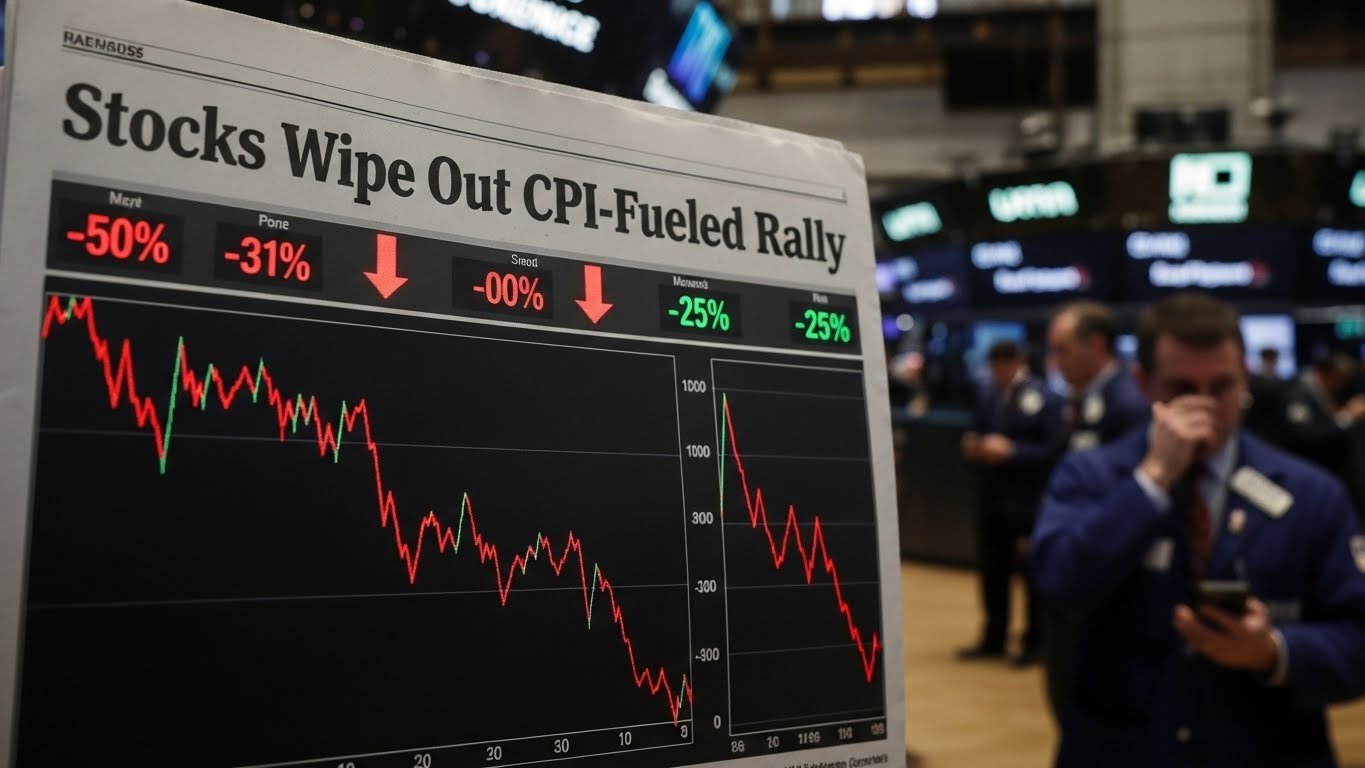
Stocks Wipe Out CPI-Fueled Gains as JPMorgan Sinks Amid Market Turmoil the global financial markets witnessed a dramatic reversal as stocks wipe out CPI-fueled gains as JPMorgan sinks, leaving investors grappling with renewed uncertainty. What initially appeared to be a positive trading session driven by encouraging inflation data quickly unraveled when heavyweight banking stocks, led by JPMorgan, came under intense selling pressure. The episode highlights the fragile balance between optimism around cooling inflation and persistent concerns about corporate earnings, financial sector stability, and broader economic momentum.
The release of the Consumer Price Index sparked early enthusiasm, reinforcing hopes that inflationary pressures were easing and that central banks might soon pivot toward a less aggressive policy stance. Equity markets surged in response, reflecting investor confidence that the worst of the inflation shock might be behind them. However, that optimism proved short-lived. As the session progressed, losses in major financial stocks erased gains across key indices, underlining how sensitive markets remain to sector-specific developments.
We explores why stocks wiped out CPI-fueled gains, the significance of JPMorgan’s decline, and what it means for investors navigating a complex macroeconomic landscape. By examining inflation trends, banking sector dynamics, investor sentiment, and global spillover effects, this article provides a comprehensive view of the forces shaping today’s markets.
CPI Data Matters to Markets
The Consumer Price Index remains one of the most closely watched economic indicators because it directly reflects inflation trends that influence monetary policy. When CPI data shows signs of moderation, markets often react positively, anticipating lower interest rates or at least a pause in rate hikes. This reaction was evident when the latest CPI figures suggested easing price pressures, triggering a broad rally across equities.
Inflation has been a dominant theme over the past several years, shaping everything from household spending to corporate profitability. As inflation surged, central banks responded with aggressive tightening, pushing borrowing costs higher and weighing on equity valuations. Any indication that inflation is cooling therefore carries outsized importance. In this case, the CPI release initially reinforced the narrative that inflation might be coming under control, prompting investors to re-enter risk assets.
Initial Market Reaction to CPI Numbers
Following the CPI announcement, stocks rallied sharply, with technology and consumer discretionary sectors leading the charge. Investors interpreted the data as a signal that the Federal Reserve could adopt a more measured approach going forward. Bond yields eased, and risk appetite improved, reflecting optimism that economic growth could continue without further monetary shocks.
However, as markets often demonstrate, initial reactions do not always tell the full story. While CPI data can influence broad sentiment, it does not eliminate underlying structural concerns. As trading progressed, attention shifted away from inflation data toward company-specific and sector-wide developments that ultimately reshaped the day’s narrative.
Stocks Wipe Out CPI-Fueled Gains as JPMorgan Sinks
The Impact of JPMorgan’s Decline
The turning point in the session came when JPMorgan shares began to slide, dragging the broader banking sector lower. As one of the largest and most influential financial institutions in the world, JPMorgan often serves as a bellwether for the health of the banking industry. Its decline sent a powerful signal to the market, undermining confidence and reversing earlier gains.
Several factors contributed to the sell-off, including concerns over net interest margins, regulatory scrutiny, and broader questions about loan growth in a slowing economy. Investors also weighed commentary around future earnings potential, reassessing whether banks could sustain profitability amid tighter financial conditions. As JPMorgan sank, other financial stocks followed, amplifying the negative momentum.
Why Financial Stocks Carry Outsized Influence
Financial stocks play a crucial role in equity indices, particularly in the United States. Banks are deeply interconnected with the broader economy, providing credit to businesses and consumers alike. When investors lose confidence in banks, it often signals broader economic anxiety. This is why the phrase stocks wipe out CPI-fueled gains as JPMorgan sinks resonates so strongly with market participants.
The decline in financials overshadowed positive signals from inflation data, reminding investors that economic transitions are rarely smooth. Even as inflation shows signs of easing, concerns about growth, credit quality, and regulatory pressures can quickly reassert themselves, reshaping market dynamics.
Banking Sector Pressures and Investor Sentiment
Structural Challenges Facing Major Banks
Beyond short-term market movements, the banking sector faces structural challenges that continue to weigh on valuations. Rising interest rates, while initially beneficial for margins, can eventually dampen loan demand and increase credit risks. At the same time, regulatory requirements have become more stringent, raising compliance costs and limiting capital flexibility.
JPMorgan, despite its scale and diversified operations, is not immune to these pressures. Investors are increasingly scrutinizing how banks manage risk in an environment characterized by slowing growth and uncertain policy signals. The recent sell-off reflects not just company-specific concerns but a broader reassessment of the sector’s outlook.
Shifting Investor Psychology
Investor sentiment remains highly reactive, oscillating between optimism and caution. The rapid reversal following the CPI-driven rally underscores how fragile confidence has become. While easing inflation provides hope, it does not erase fears of recession, earnings slowdowns, or financial instability.
Market participants are increasingly selective, favoring sectors perceived as resilient while reducing exposure to areas seen as vulnerable. This cautious approach explains why gains fueled by macro data can be quickly erased by negative developments in influential sectors like banking.
Broader Market Implications
Equity Indices and Sector Performance
As stocks wiped out CPI-fueled gains, major indices closed lower, reflecting broad-based weakness. Technology shares gave back early advances, while cyclical sectors struggled amid concerns about economic momentum. Defensive sectors fared slightly better, but not enough to offset losses elsewhere.
The divergence between early optimism and late-session pessimism highlights the complex interplay between macroeconomic data and corporate fundamentals. Markets are no longer driven by single narratives; instead, they respond to a mosaic of signals that can shift rapidly throughout the trading day.
Volatility and Risk Management
Heightened volatility has become a defining feature of current markets. Sudden reversals, like the one triggered when JPMorgan sank, emphasize the importance of risk management. Investors are increasingly focused on diversification and downside protection, recognizing that rallies can be fleeting.
This environment favors disciplined strategies over speculative bets. Understanding why stocks wipe out CPI-fueled gains as JPMorgan sinks helps investors appreciate the need for caution, even when headline data appears encouraging.
Global Market Repercussions
International Equity Markets React
The reversal in U.S. markets reverberated globally, influencing sentiment across Europe and Asia. International investors closely monitor U.S. financial stocks, viewing them as indicators of global economic health. Weakness in JPMorgan and its peers raised concerns about spillover effects, particularly in regions with close financial ties to the United States.
European banks faced renewed scrutiny, while Asian markets showed mixed reactions as investors weighed local factors against global headwinds. The episode reinforced the interconnected nature of modern financial markets, where developments in one region can quickly impact others.
Currency and Commodity Movements
Currency markets also responded to shifting risk sentiment. The dollar strengthened as investors sought safe-haven assets, while risk-sensitive currencies came under pressure. Commodities displayed mixed performance, with energy prices influenced by demand concerns and precious metals reflecting hedging activity.
These cross-asset movements underscore how a single narrative, such as stocks wiping out CPI-fueled gains, can ripple across multiple markets, shaping global financial conditions.
Inflation, Monetary Policy, and the Road Ahead
Central Bank Considerations
Despite the market reversal, CPI data remains significant for policymakers. Central banks continue to emphasize data dependence, balancing the need to control inflation with the risk of overtightening. While easing inflation provides some relief, officials remain cautious, mindful of lingering price pressures and economic uncertainties.
Market participants will closely monitor future data releases, including employment and wage figures, to gauge whether inflation trends are sustainable. The interplay between these indicators and financial market reactions will shape expectations for interest rates and policy direction.
Long-Term Market Outlook
Looking ahead, the market’s ability to sustain rallies will depend on more than just inflation data. Corporate earnings, credit conditions, and geopolitical developments will all play critical roles. The episode in which stocks wiped out CPI-fueled gains serves as a reminder that transitions in economic cycles are often marked by volatility and false starts.
Investors who understand these dynamics are better positioned to navigate uncertainty. Rather than reacting to short-term swings, a focus on fundamentals and long-term trends can provide greater resilience in turbulent markets.
Conclusion
The session in which stocks wipe out CPI-fueled gains as JPMorgan sinks encapsulates the challenges facing today’s financial markets. Encouraging inflation data initially fueled optimism, but underlying concerns about the banking sector and economic momentum quickly resurfaced, reversing gains and unsettling investors. JPMorgan’s decline underscored the influence of financial stocks and highlighted the fragility of market confidence.
As inflation shows signs of easing, markets remain caught between hope and caution. The path forward will likely be uneven, shaped by a complex mix of macroeconomic data, corporate performance, and policy decisions. For investors, understanding these dynamics is essential to making informed decisions in an environment where sentiment can shift rapidly.
FAQs
Q: Why did stocks wipe out CPI-fueled gains despite positive inflation data?
The rally driven by CPI data was undermined by renewed concerns about the banking sector, particularly after JPMorgan shares fell sharply. Investors shifted focus from easing inflation to worries about earnings, credit conditions, and financial stability, leading to a broad market reversal.
Q: How significant is JPMorgan’s role in influencing market sentiment?
JPMorgan is widely viewed as a bellwether for the global banking sector. Its performance often shapes investor perceptions of financial stability. When JPMorgan sinks, it can trigger broader sell-offs as confidence in the sector and the economy weakens.
Q: Does easing inflation guarantee sustained stock market gains?
Easing inflation is supportive for markets, but it does not guarantee sustained gains. Other factors such as corporate earnings, economic growth, and sector-specific challenges can override positive inflation trends, as seen when stocks wiped out CPI-fueled gains.
Q: What does this market reversal mean for long-term investors?
For long-term investors, the reversal highlights the importance of focusing on fundamentals rather than short-term market reactions. Volatility is likely to persist, making diversification and disciplined strategies crucial for navigating uncertain conditions.
Q: How might future CPI reports impact markets going forward?
Future CPI reports will continue to influence expectations around monetary policy. Consistent signs of easing inflation could support markets, but reactions will also depend on other economic data and corporate developments that shape overall investor confidence.
