


Transforming Financial Wellness through Artificial Intelligence and the Metaverse has emerged as one of the most exciting and impactful shifts in how people manage money, plan for the future, and engage with financial education. Traditionally, financial wellness focused on simple concepts like budgeting and saving. However, advancements in AI technology and the rise of immersive experiences in the metaverse are propelling financial wellness into a new technological frontier where personalized insights and engaging virtual environments converge. Individuals no longer rely solely on static spreadsheets or generic advice; instead, intelligent systems are offering tailored strategies and dynamic scenarios that empower people to make smarter financial decisions.
The combination of artificial intelligence and the metaverse represents more than a trend. It’s a transformative fusion of data-driven decision support, immersive simulation, and interactive learning environments designed to enhance financial confidence and inspire meaningful change. With AI’s predictive capabilities and the metaverse’s limitless potential for virtual interaction, users can explore financial concepts in engaging, risk-free settings that bridge the gap between theory and real-world outcomes. This convergence is shaping how people, institutions, and communities approach financial well-being—from automated budgeting tools to virtual seminars in digital worlds that facilitate real-time financial learning.
We will explore how these technologies improve financial literacy, support personalized planning, and foster new opportunities for inclusive financial engagement. By unpacking key innovations, challenges, and future potential, this article provides a deep look at why this transformation matters and how it is empowering individuals in a digital-first world.
Redefining Financial Wellness in a Digital Era
Financial wellness today encompasses far more than basic money management. It includes financial confidence, long-term goal setting, emotional stability around money, and access to tools that help individuals adapt to changing economic conditions. This broader definition reflects the complexities of modern life, where financial decisions are influenced by everything from market volatility to personal health expenses. In response, technology has stepped in to bridge gaps that traditional financial services could not fully address.
Artificial intelligence and the metaverse are at the forefront of this shift. AI can analyze vast datasets to deliver personalized financial strategies, while the metaverse offers immersive educational environments where users can experiment with financial decisions in a realistic yet controlled setting. This means that financial wellness is not just about knowing what to do—but also about experiencing it in ways that build confidence and understanding.
Why Technology Is Central to Financial Empowerment
Technology plays a critical role in empowering people to take control of their financial lives. Digital tools provide real-time feedback, tailored recommendations, and simulated environments that help users practice financial decision-making without risk. This integration of data and experience promotes proactive rather than reactive financial behavior, fostering a higher level of financial awareness and skill.
AI’s capabilities in predictive analytics and automation make personalized financial planning accessible to everyone—not just those who can afford professional advisors. Meanwhile, the metaverse transforms learning and interaction into immersive experiences that can appeal to diverse audiences. Together, these technologies are democratizing financial literacy and reshaping how individuals engage with their financial wellness journey.
Personalization Through AI-Driven Insights
Artificial intelligence has swiftly transitioned from a buzzword to a practical tool in personal finance. Modern AI systems can assess spending patterns, income streams, financial goals, and risk tolerance to deliver highly personalized recommendations in real time. Unlike traditional financial tools that relied on manual input and static rules, AI continuously learns from user behavior, adapting its guidance to reflect changing life circumstances.
This personalized financial guidance is crucial to financial wellness, especially when individuals face complex decisions like planning for retirement, managing debt, or optimizing investments. By tailoring insights to individual needs, AI empowers users to make informed choices with confidence—bringing a level of precision and relevance that was previously reserved for high-end financial advisors.
Predictive Analytics and Smarter Decision Support
Predictive analytics is one of the most powerful applications of AI in financial wellness. By analyzing historical financial data and detecting patterns, AI can forecast future spending, potential shortfalls, and opportunities for growth. This foresight allows individuals to proactively adjust financial plans rather than reacting to unforeseen challenges.
Predictive AI also plays a meaningful role in investment planning, where simulating market scenarios and risk profiles gives users a clearer picture of how their decisions may unfold over time. The result is a financial planning experience that supports foresight, strategy, and adaptability—essential components of long-term financial wellness.
Emotional Intelligence and Behavioral Insights
Financial behavior is not driven by numbers alone. Emotions such as fear, confidence, and anxiety often influence how people handle money. Advanced AI systems are being designed to recognize behavioral patterns and provide supportive guidance that considers psychological factors as well as financial metrics. These emotionally intelligent tools identify spending habits that may reflect stress or impulsivity and offer tailored nudges that encourage healthier choices.
By bridging cognitive and emotional dimensions, AI contributes to a more holistic approach to financial wellness—where users feel supported rather than judged. This combination of analytical precision and emotional awareness is helping users build not only better financial outcomes but also a healthier relationship with money.
What the Metaverse Offers to Financial Wellness
The metaverse is a connected virtual world where users interact in immersive digital spaces using avatars and digital representations. While the concept originated in science fiction, it has evolved into a technological phenomenon that integrates virtual, augmented, and mixed reality to create persistent environments where people can socialize, work, and learn.
For financial wellness, the metaverse provides an interactive platform where users can engage with financial education, planning tools, and virtual communities in ways that transcend traditional interfaces. Rather than static screens and charts, users can step into simulated scenarios where they make decisions, observe consequences, and reflect on outcomes—essentially learning by doing.
Immersive Financial Education and Risk-Free Practice
One of the most compelling applications of the metaverse is immersive financial education. In a virtual world, users can participate in interactive workshops, explore financial simulations, and test decision-making strategies without risking real assets. For example, a virtual investment workshop might present users with market scenarios where they can allocate virtual assets and see how different choices play out over time.
These simulations help build intuition around complex financial concepts such as compound growth, asset diversification, and retirement planning. By fostering experiential learning, the metaverse can make financial knowledge more tangible and memorable—especially for audiences that find traditional education methods disengaging or intimidating.
Metaverse Economies and Digital Asset Literacy
Beyond education, the metaverse introduces users to digital economies where virtual assets, cryptocurrencies, and blockchain-based ownership models are part of everyday transactions. These virtual experiences reflect real economic principles and encourage users to think critically about value, scarcity, and investment.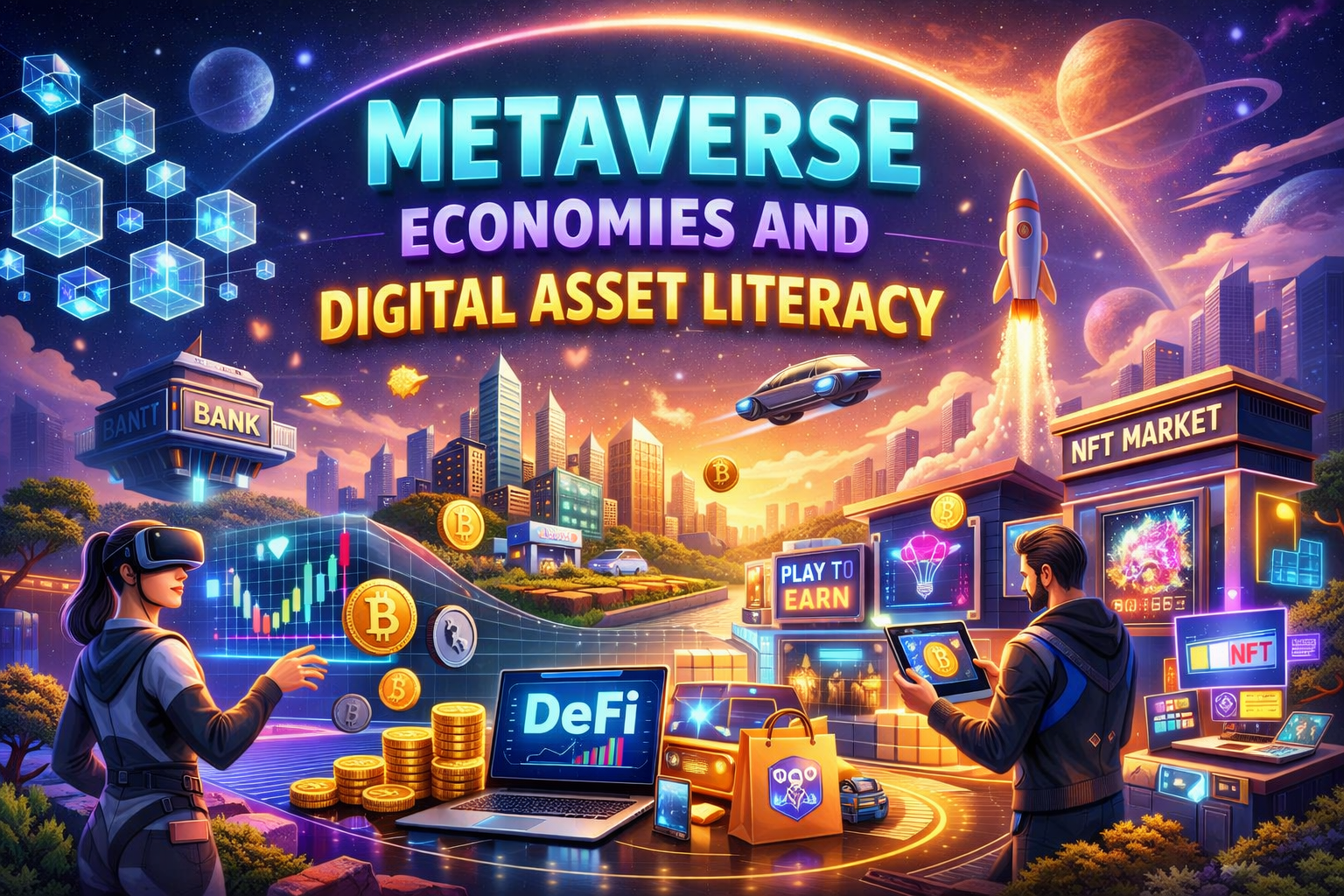
Understanding digital asset management is becoming an essential component of modern financial literacy, as virtual and traditional financial systems increasingly intersect. The metaverse provides a safe and engaging environment to explore these concepts and prepare users for a future where digital finance plays a growing role in wealth management and economic participation.
The Synergy Between AI and the Metaverse
Combining Immersive Experiences with Intelligent Guidance
The most powerful aspect of transforming financial wellness through artificial intelligence and the metaverse is the synergy between immersive environments and intelligent guidance. AI serves as the analytical brain that interprets data, learns user behavior, and generates personalized insights. At the same time, the metaverse provides the experiential interface where these insights come to life through engaging, interactive experiences.
Imagine entering a virtual financial planning center where an AI-powered agent greets you, asks questions about your goals, and presents customized simulations. You set projected retirement goals, test spending strategies, and receive real-time visual feedback—all within a dynamic virtual space. This level of personalized, interactive financial support makes abstract concepts tangible and encourages users to invest in their financial futures.
Real-Time Learning and Continuous Adaptation
The integration of AI with metaverse environments enables real-time feedback that adjusts to user interactions. As individuals explore virtual financial scenarios, AI analyzes behavior and outcomes, refining future recommendations and learning pathways. This continuous adaptation creates a living educational ecosystem that evolves with the user.
Interactive AI agents can guide users through training modules, assess readiness for advanced financial tasks, and celebrate milestones. These gamified elements make financial learning engaging and encourage ongoing participation—turning what was once a dry topic into an immersive journey toward financial empowerment.
Visualization and Trust in Financial Decision-Making
One of the persistent challenges in financial planning is translating abstract data into actionable insights. The metaverse’s immersive visualization tools help simplify complex financial information by presenting it in intuitive formats. AI enhances this experience by contextualizing the data and providing clear explanations, transforming confusion into clarity.
This combination of visualization and intelligent explanation strengthens trust, reduces anxiety around financial themes, and encourages users to engage more deeply with their financial plans.
AI-Powered Financial Wellness Platforms
AI-driven financial wellness platforms are already making significant impacts by offering personalized recommendations, automated savings strategies, and predictive analytics. These tools help individuals track expenses, create realistic budgets, and receive actionable financial advice. Unlike traditional one-size-fits-all models, these platforms tailor guidance based on unique user profiles, driving more meaningful engagement and better financial outcomes.
Virtual Financial Education Communities
In the metaverse, virtual financial education communities allow users to attend interactive events, consult with avatars of financial professionals, and participate in group learning environments. These spaces make financial learning social and collaborative—transforming it from a solitary task into a shared experience that reinforces understanding and motivation.
Personalized Virtual Advisors
Financial institutions are exploring the idea of AI-powered virtual advisors that reside within the metaverse. These intelligent avatars can guide users through financial planning sessions, answer questions in natural language, and tailor strategies based on real-time inputs. This fusion of AI and metaverse interaction delivers personalized support that feels intuitive, responsive, and human-centric.
Challenges and Ethical Considerations
Data Privacy and Security
As financial data becomes integrated with AI and metaverse experiences, privacy and security concerns are paramount. Users must trust that their sensitive financial information is protected and used ethically. Strong data governance, transparent policies, and secure infrastructure are essential to building confidence in these advanced systems.
Ethical Use of AI and Bias Mitigation
AI systems must be designed to avoid algorithmic bias and ensure equitable access to financial wellness tools. Ethical considerations include fairness, transparency in how recommendations are generated, and ensuring that AI does not inadvertently disadvantage certain groups of users.
Accessibility and Inclusive Design
For transformative technologies to benefit everyone, they must be accessible to users with varying levels of digital literacy. Simplified interfaces, educational support, and inclusive design principles ensure that financial wellness tools powered by AI and the metaverse do not exclude underserved populations.
The Future of Financial Wellness
Looking ahead, the integration of artificial intelligence and the metaverse will continue to deepen, creating even more personalized and engaging pathways toward financial wellness. As these technologies mature, users will benefit from tools that adapt in real time, deliver rich experiential learning, and support financial decision-making with precision and empathy. The future of financial wellness lies at the intersection of human creativity and technological innovation—where AI intelligence and immersive virtual worlds together empower individuals to build healthier, more resilient financial lives.
Conclusion
Transforming financial wellness through artificial intelligence and the metaverse represents a paradigm shift in personal finance. By combining AI’s analytical power with the immersive potential of the metaverse, individuals now have access to tools that were once inaccessible or too complex for everyday use. From tailored financial guidance and predictive insights to immersive education and virtual planning environments, these technologies are reshaping how people learn about, interact with, and manage their financial lives.
As this transformation continues, the potential for inclusive access, deeper engagement, and lifelong financial learning will expand—empowering individuals across demographics to pursue financial well-being with confidence and clarity.
FAQs
Q. What does transforming financial wellness through artificial intelligence and the metaverse mean?
It means using AI’s analytical capabilities and the immersive, interactive environments of the metaverse to enhance financial education, planning, and engagement in personalized, dynamic ways.
Q. How does AI help improve personal financial wellness?
AI helps by analyzing financial data, delivering personalized recommendations, predicting future trends, and automating tasks such as budgeting and savings strategies to support informed financial decisions.
Q. What role does the metaverse play in financial education?
The metaverse offers immersive experiences where users can learn financial concepts through interactive scenarios, simulations, and virtual community interactions that make learning engaging and practical.
Q. Are there risks associated with financial activities in the metaverse?
Yes, challenges include data privacy concerns, regulatory uncertainty, and the need for digital literacy to navigate complex virtual financial systems effectively.
Q. How can individuals get started with AI-driven financial wellness tools?
Users can begin by exploring AI-powered budgeting and financial planning apps, participating in virtual financial education events, and experimenting with metaverse platforms that offer financial learning experiences.
